




























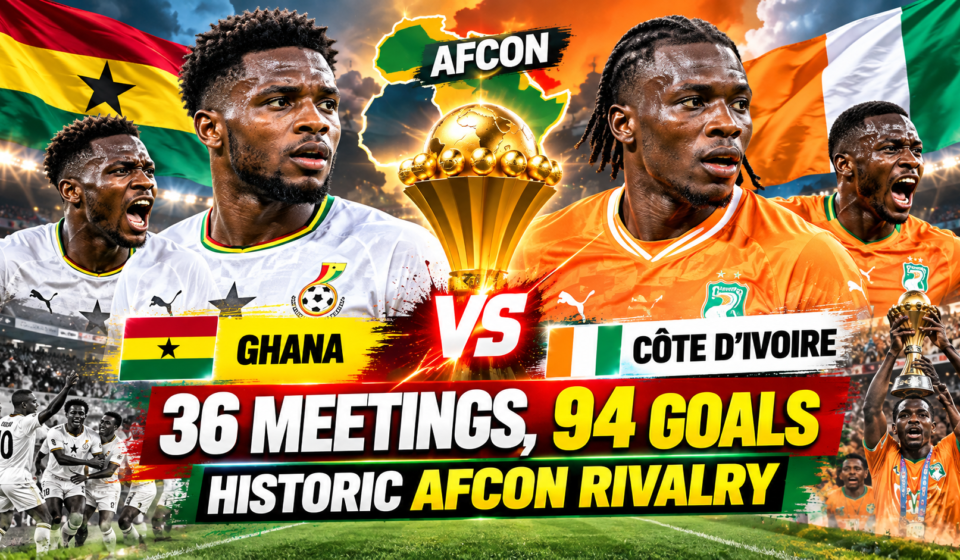

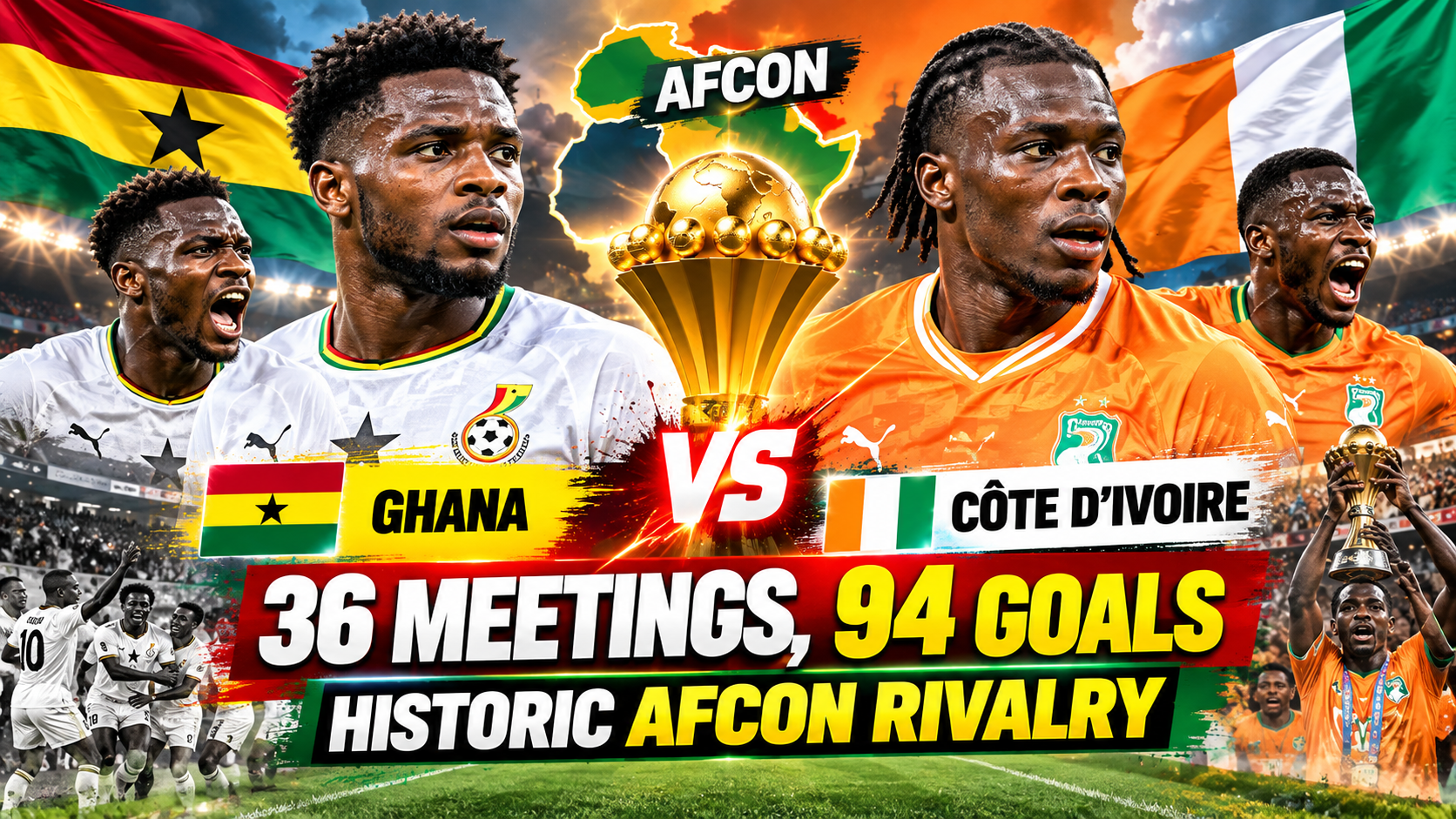
36 Meetings, 94 Goals, Two AFCON Finals: Ghana vs Côte d’Ivoire Rivalry in Numbers
Ghana and Côte d’Ivoire renew one of West Africa’s most enduring football rivalries on Thursday, September 24, 2026, when the Black Stars travel to Bouaké for their opening 2027 Africa Cup of Nations (AFCON) qualifier.
The fixture is more than another competitive match on the international football calendar. It brings together two neighbouring football nations with decades of history, continental success, memorable tournament battles and some of the most dramatic penalty shootouts in AFCON history.
According to the historical head-to-head record being used for the match preview, Ghana and Côte d’Ivoire have met 36 times, with Ghana holding a narrow advantage of 13 victories to Côte d’Ivoire’s 12, while 11 matches have ended in draws. The same tally gives Ghana 50 goals and Côte d’Ivoire 44, meaning the two nations have produced 94 goals across those 36 meetings. (Africa Top Sports)
That one-match difference in victories shows just how closely matched the two countries have been over generations. Neither side has been able to establish long-term dominance, and the rivalry has repeatedly produced matches decided by small margins, tactical discipline and, on two famous occasions, penalty shootouts.
Thursday’s encounter therefore carries historical significance as well as qualification importance.
For Ghana, it is the beginning of another attempt to return to the top level of African football after recent disappointment in continental competition. For Côte d’Ivoire, it is an opportunity to use home advantage and begin the qualification campaign with an important result.
For more Ghana football news, Black Stars updates and AFCON coverage, readers can follow the MyGHPages Sports section.
Ghana vs Côte d’Ivoire: 36 Meetings of West African Football History
Few international rivalries in West Africa have produced such a balanced record.
Across 36 previous meetings, Ghana’s 13 victories give the Black Stars only a one-win advantage over Côte d’Ivoire’s 12. The remaining 11 matches have ended in draws.
The goal figures are similarly close. Ghana have scored 50 goals in the historical tally, while Côte d’Ivoire have scored 44.
That means the total number of goals across the 36 meetings stands at 94.
The figures tell an important story about the nature of the rivalry. These have generally not been one-sided encounters in which one country consistently dominates the other. Instead, the results have moved between Ghana and Côte d’Ivoire depending on the generation, competition, venue and players available.
The rivalry has also survived several different eras of African football.
Players such as Abedi Pele, Anthony Yeboah, Michael Essien, Didier Drogba and many other continental stars have been involved in the broader history of Ghana-Côte d’Ivoire football battles.
Today’s generation is now creating its own chapter, with players and coaches facing a different football environment shaped by professional contracts, international scouting, sports broadcasting, digital media, sponsorship and the growing commercial value of African football.
That makes Thursday’s AFCON qualifier important not only for points but also for player visibility and national-team development.
Why the 94-Goal Figure Matters
A total of 94 goals across 36 meetings represents an average of more than two goals per match when the historical tally is considered.
However, the average does not fully explain the rivalry.
Some matches have produced multiple goals, while others have become defensive battles decided by a single moment.
The two AFCON finals between Ghana and Côte d’Ivoire are the clearest examples.
Both ended 0-0 after 120 minutes.
Both went to penalties.
And Côte d’Ivoire won both.
That contrast is one of the most fascinating aspects of the rivalry. The overall head-to-head record has produced plenty of goals, but when the two countries met with the AFCON trophy on the line, neither team could score during open play.
CAF’s historical records confirm that Côte d’Ivoire won the 1992 and 2015 AFCON finals against Ghana on penalties, with both finals ending goalless after extra time. (Confédération Africaine de Football)
The 94-goal figure therefore provides a statistical backdrop to a rivalry that has repeatedly demonstrated how unpredictable high-pressure matches can become.
Bouaké Adds Another Layer to the Story
The location of Thursday’s qualifier makes the fixture even more interesting.
Ghana will play at Stade de la Paix in Bouaké, a city that carries painful memories for generations of Black Stars supporters.
The connection goes back to the 1984 Africa Cup of Nations, which was hosted by Côte d’Ivoire.
Ghana entered that tournament as defending champions and four-time AFCON winners. The Black Stars had won the continental title in 1963, 1965, 1978 and 1982, making them one of Africa’s most successful national teams at the time.
Expectations were therefore extremely high.
Instead, the tournament became one of the most disappointing campaigns in Ghana’s AFCON history.
Ghana were placed in a group with Nigeria, Algeria and Malawi, with the group matches played in Bouaké.
The campaign started with a 2-1 defeat to Nigeria. Ghana then suffered a 2-0 loss to Algeria before beating Malawi 1-0 in the final group game.
The victory over Malawi was not enough.
Ghana finished third in the group and failed to advance to the semi-finals.
The campaign subsequently became known in Ghanaian football history as the “Bouaké Debacle”. Contemporary and retrospective accounts have connected the disappointing tournament with issues surrounding team selection and a late coaching change. (Pulse Ghana)
More than four decades later, Ghana are returning to the same city.
The circumstances are completely different, but the historical connection is impossible to ignore.
The 1984 Tournament Remains Part of Ghana’s Football Memory
The 1984 AFCON campaign remains significant because of the expectations surrounding the Ghana team.
The Black Stars had won the 1982 tournament in Libya and arrived in Côte d’Ivoire as holders.
The team included several respected Ghanaian footballers, and supporters expected another deep run in the competition.
Instead, the opening defeat to Nigeria placed the team under immediate pressure.
The 2-0 defeat against Algeria made qualification even more difficult.
By the time Ghana defeated Malawi, the damage had already been done.
The story has since become part of Ghanaian football folklore.
Returning to Bouaké in 2026 therefore provides a fascinating historical connection. The players of today were not responsible for the events of 1984, and the modern Black Stars are operating in a completely different football environment.
Yet football history often gives stadiums an identity.
For Ghanaian supporters, Bouaké is not simply another venue. It carries memories of an earlier generation and one of the country’s most disappointing AFCON campaigns.
That background will add another layer of interest to Thursday’s match.
Ghana and Côte d’Ivoire Have Met in Two AFCON Finals
The most famous part of this rivalry is undoubtedly the two AFCON finals.
Ghana and Côte d’Ivoire have met twice in the final of Africa’s premier international tournament.
Côte d’Ivoire won both.
But the manner of those victories is what made the matches legendary.
The first final took place in 1992.
After 120 minutes, the score remained 0-0.
The match then went into a marathon penalty shootout.
Côte d’Ivoire eventually won 11-10.
CAF describes the 1992 final as a shootout that lasted 24 penalty kicks, with Ghana’s Tony Baffoe missing the decisive attempt. (Confédération Africaine de Football)
It remains one of the longest and most dramatic penalty shootouts in AFCON history.
For Ghana, it was an agonising way to lose the continental championship.
For Côte d’Ivoire, it delivered their first AFCON title.
The two countries would eventually meet again in another AFCON final more than two decades later.
The 2015 Final Repeated the Drama
The 2015 AFCON final in Bata, Equatorial Guinea, produced an almost unbelievable repeat of the 1992 story.
Ghana and Côte d’Ivoire played 120 minutes without scoring.
Once again, the trophy had to be decided by penalties.
And once again, Côte d’Ivoire prevailed.
The shootout ended 9-8 in favour of Côte d’Ivoire, after the match itself finished 0-0 following extra time. CAF’s official report records the dramatic sequence, including Boubacar Barry’s decisive contribution for the Ivorians. (Confédération Africaine de Football)
The 2015 final became particularly memorable because Côte d’Ivoire had already suffered disappointment in previous AFCON finals.
The victory finally gave the Elephants another continental championship, while Ghana was left with another painful final defeat.
CAF’s records note that Côte d’Ivoire’s first two AFCON titles came in 1992 and 2015, with Ghana beaten in the final on penalties on both occasions. (Confédération Africaine de Football)
Two Finals, Zero Goals After 120 Minutes
One of the strangest statistics in the Ghana-Côte d’Ivoire rivalry is that neither of their two AFCON finals produced a goal during regulation or extra time.
That means the teams played a combined 240 minutes of AFCON final football without scoring against each other.
Yet the matches produced 20 successful or decisive penalty moments across the two shootouts and enormous drama for supporters.
The statistic demonstrates how different knockout football can be from ordinary head-to-head matches.
A team can dominate possession, create chances and still find itself unable to score.
A goalkeeper can become the most important player of the night.
A penalty taker can become either a national hero or a historical figure remembered for a missed kick.
That is exactly what happened in these two finals.
Ghana’s Memorable AFCON Wins Over Côte d’Ivoire
Although Côte d’Ivoire won the two AFCON finals, Ghana have also produced important victories against their neighbours at the continental tournament.
One of Ghana’s earliest major wins came at the 1965 AFCON, when the Black Stars defeated Côte d’Ivoire 4-1.
That result demonstrated Ghana’s strength during an era when the country was establishing itself as one of Africa’s leading football nations.
Ghana’s football development during that period laid the foundation for the country’s long-term continental reputation.
The Black Stars later produced another significant victory at the 1996 AFCON, defeating Côte d’Ivoire 2-0.
That result remains another important chapter in the historical record between the two nations.
At the 2008 AFCON in Accra, Ghana also defeated Côte d’Ivoire 4-2 in a high-scoring encounter.
That match was played in front of passionate home support and demonstrated how dangerous the Black Stars could be when attacking with confidence.
For fans searching for more historical and current Ghana sports news, the MyGHPages Sports archive contains additional football stories and Black Stars coverage.
Côte d’Ivoire Have Also Produced Major Victories
The rivalry has never been one-way.
Côte d’Ivoire have recorded significant wins over Ghana across different generations.
At the 2000 AFCON, the Elephants defeated the Black Stars 2-0.
Ten years later, Côte d’Ivoire secured another major tournament victory with a 3-1 win over Ghana at the 2010 AFCON in Angola.
Those results demonstrate why the historical record remains so close.
Whenever one side begins to establish momentum, the other has often found a way to respond in another era.
That competitive balance has helped turn Ghana versus Côte d’Ivoire into one of the region’s most recognisable football fixtures.
The 2021 Meeting Ended Without a Goal
The most recent senior men’s meeting cited in the historical preview before Thursday’s qualifier was a friendly played in Cape Coast in June 2021.
That match ended 0-0.
It was another example of the defensive character that has occasionally defined this rivalry.
The result also continued a pattern of close encounters between the two countries.
Rather than producing a clear winner, the teams once again cancelled each other out.
Five years later, the next meeting comes in a much more important setting.
This time, there are competitive points at stake in the 2027 AFCON qualifying campaign.
Thursday’s Match Is More Than a Friendly Rivalry
Unlike some previous Ghana-Côte d’Ivoire meetings, Thursday’s fixture is not an exhibition match.
It is an official AFCON qualifier.
That changes the tactical and financial stakes.
Three points at the beginning of a qualification campaign can have significant consequences for a team’s position in the group.
The match also has commercial value because major international football fixtures attract television audiences, digital traffic, advertising revenue, sponsorship interest and social media engagement.
For players, competitive international matches provide exposure to clubs, scouts and football decision-makers.
For broadcasters and digital publishers, the fixture creates demand for live scores, starting lineups, match previews, player statistics, injury updates and post-match analysis.
For supporters, however, the main issue remains football pride.
Ghana and Côte d’Ivoire are neighbours, and matches between them rarely feel ordinary.
The Commercial Growth of Ghanaian Football
Football in Ghana has become increasingly connected to digital media, sponsorship, broadcasting and sports technology.
Major Black Stars fixtures can generate substantial online search interest as supporters look for squad announcements, player updates, match schedules and results.
The financial side of football is also becoming more visible.
FIFA development funding, commercial partnerships and investments in football infrastructure all contribute to the broader football economy.
Readers interested in this side of the game can read about Ghana’s FIFA football funding and its potential impact on football development.
The commercial ecosystem surrounding football is important because a national team does not operate only on match day.
Training facilities, medical teams, coaching staff, sports science, travel, player development, broadcasting and youth development all require investment.
A major international rivalry can therefore have consequences that extend beyond the final whistle.
Why Head-to-Head Statistics Matter
Historical statistics cannot determine what will happen in a football match.
They can, however, provide context.
The 36-meeting record shows that Ghana and Côte d’Ivoire have been extremely difficult to separate historically.
A one-win difference across such a long period illustrates the competitiveness of the fixture.
The 94 goals in the historical tally also show that the rivalry has produced enough attacking moments to remain one of the most interesting statistical matchups in West African football.
Yet the two AFCON finals demonstrate that historical averages can disappear when the stakes rise.
Those matches ended 0-0.
The 1992 final required 24 penalty kicks.
The 2015 final required another dramatic shootout.
That is why supporters should be careful when using historical statistics to predict a modern match.
The numbers explain the past.
They do not write the future.
The Rivalry Has Survived Generational Changes
Another reason the Ghana-Côte d’Ivoire rivalry remains significant is its ability to survive changes in personnel.
The players from the 1960s are long gone.
The stars of the 1990s have retired.
The generation associated with Didier Drogba, Michael Essien and other continental icons has also moved into football history.
A new generation is now carrying the rivalry forward.
For Ghana, players such as Fatawu Issahaku and Ernest Nuamah represent part of the country’s emerging attacking generation.
Côte d’Ivoire also have a new group of players trying to establish themselves at international level.
The coaches have changed too.
Ghana are under Carlos Queiroz, while Côte d’Ivoire are led by Hervé Renard.
The tactical ideas of modern football are different from those used decades ago.
Yet the emotional significance remains remarkably similar.
Bouaké Could Become Another Historic Chapter
The return to Bouaké gives Thursday’s match an additional historical dimension.
In 1984, Ghana left the city disappointed after failing to reach the semi-finals of the AFCON.
In 2026, the Black Stars return with a different objective.
This time, they are not defending an AFCON title.
They are attempting to collect points in the qualification process.
That difference matters.
The modern Ghana team is beginning another continental cycle and will need to navigate the qualification campaign over several matches.
A positive result in Bouaké would provide an important foundation for the group campaign, while Côte d’Ivoire will be determined to make home advantage count.
The historical record may be close, but the circumstances surrounding the 2026 fixture are unique.
What the 36 Meetings Tell Us
The first major statistic is the number of meetings: 36.
The second is Ghana’s 13 wins.
The third is Côte d’Ivoire’s 12 victories.
The fourth is the 11 draws.
The fifth is the 94-goal combined tally in the historical record used for this preview.
Put together, those numbers reveal a rivalry that has rarely been dominated by one country.
Ghana’s one-win advantage is extremely narrow.
Côte d’Ivoire are only one victory away from bringing the overall win count level.
That gives Thursday’s fixture another interesting statistical angle.
A victory for Côte d’Ivoire would bring the historical win totals to 13 apiece.
A Ghana victory would extend the Black Stars’ advantage to two matches.
A draw would preserve the existing one-win gap.
That simple mathematical possibility adds another layer to an already important fixture.
The AFCON Finals Tell an Even Bigger Story
The two AFCON finals may be the most important historical statistics of all.
Ghana and Côte d’Ivoire have played two finals against each other.
Côte d’Ivoire won both.
Both finals ended 0-0 after extra time.
Both were decided on penalties.
The 1992 shootout finished 11-10.
The 2015 shootout finished 9-8.
These results are now permanently connected to the rivalry.
CAF’s historical records also show the unusual pattern in Côte d’Ivoire’s AFCON final history: their four finals before the 2023 tournament all ended 0-0 after extra time, with two victories and two defeats on penalties. (Confédération Africaine de Football)
That makes Ghana particularly significant in Côte d’Ivoire’s AFCON history because the Black Stars were the opponents in both of their title-winning finals.
A New Chapter Begins in Bouaké
Thursday’s match will not erase what happened in 1984.
It will not change the outcome of the 1992 final.
It will not alter the 2015 penalty shootout.
It will not remove the victories recorded by either country across previous decades.
But it will add another result to the historical record.
That is how football rivalries grow.
Every generation inherits the history and then creates something new.
For Ghana, the objective will be to begin the 2027 AFCON qualification campaign strongly.
For Côte d’Ivoire, the home fixture offers the chance to begin their own campaign with three points and potentially move closer to matching Ghana’s historical win total.
The match also provides a new generation of players with the opportunity to become part of a rivalry that has already produced some of African football’s most memorable moments.
Ghana vs Côte d’Ivoire: Numbers That Define the Rivalry
The historical figures make the significance of this fixture easy to understand.
Thirty-six previous meetings.
Thirteen Ghana victories.
Twelve Côte d’Ivoire victories.
Eleven draws.
Fifty Ghana goals.
Forty-four Côte d’Ivoire goals.
Ninety-four goals combined.
Two AFCON finals.
Two goalless finals after 120 minutes.
Two Côte d’Ivoire victories on penalties.
And one historic city that Ghanaian supporters still associate with disappointment.
Those statistics provide the background, but the next chapter will be written by the players on the pitch.
The 2027 AFCON qualifier in Bouaké gives Ghana and Côte d’Ivoire another opportunity to demonstrate why this remains one of West Africa’s most compelling football rivalries.
For fans following the Black Stars, the match also comes at an important stage of Ghana’s football calendar. Readers can continue following Ghana Black Stars team news and AFCON updates on MyGHPages, including the latest squad developments and match coverage.
As the two teams prepare to meet again, the historical record shows that there is very little separating them. Ghana has the narrow statistical advantage, Côte d’Ivoire has the stronger record in their two AFCON final meetings, and Bouaké carries memories that make this particular fixture even more intriguing.
The numbers belong to history.
The next 90 minutes belong to the players.
Source: CAF historical records and contemporary reporting on the Ghana-Côte d’Ivoire rivalry. CAF confirms the two AFCON final victories for Côte d’Ivoire in 1992 and 2015 and Ghana’s four AFCON titles. (Confédération Africaine de Football)