“Not a Catastrophe” – Michael Carrick Dismisses Manchester United Job Fears After Difficult Week
Manchester United manager Michael Carrick has dismissed concerns over his position at Old Trafford, insisting that a difficult run of results does not mean the club is facing a catastrophe or that his future should suddenly become a major talking point.
Carrick’s comments come at a particularly important moment for Manchester United, with the club preparing for a Premier League trip to Fulham after a week that produced significant disappointment. A home defeat by Manchester City was followed by a dramatic Carabao Cup setback against Brighton, increasing pressure around the team and prompting questions about performances, squad depth, recruitment and the direction of the club.
Despite the growing discussion among supporters and football commentators, Carrick has made it clear that he is not allowing speculation about his job security to dominate his thinking. The Manchester United head coach believes the focus must remain on improving performances, finding solutions and making sure the club responds positively on the pitch.
For a club as globally recognised as Manchester United, every result is examined closely. Poor performances can quickly become major talking points across sports media, football news websites, social media platforms and international broadcasting networks. Carrick acknowledged that reality but insisted that the team cannot allow external noise to dictate its approach. 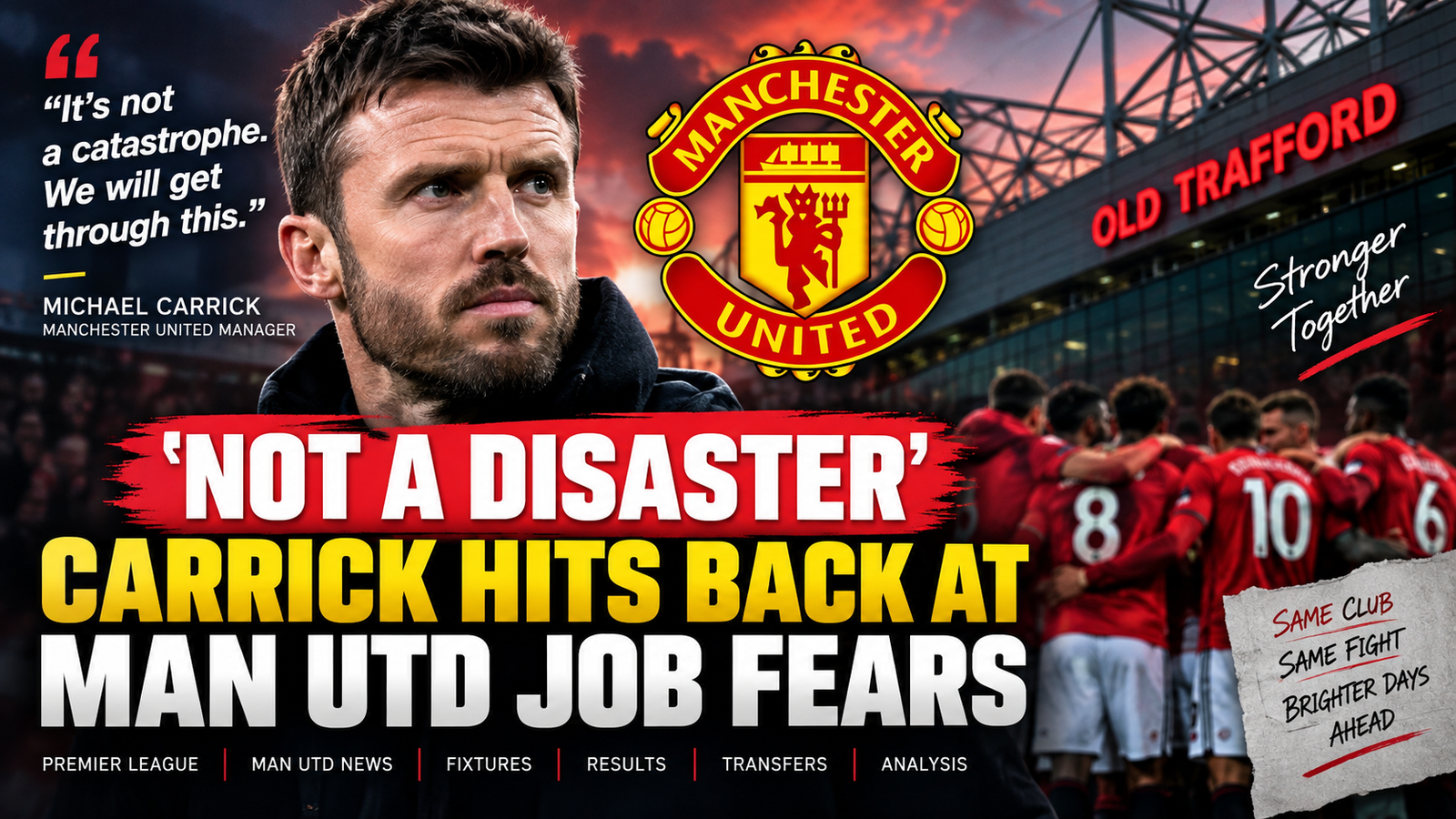
Michael Carrick rejects Manchester United job speculation.
Carrick has enjoyed a strong period since taking permanent charge of Manchester United in January 2026, winning 14 of his first 23 matches according to the figures surrounding his tenure. His record during the second half of the previous season helped create expectations that United could continue developing under his leadership.
However, the beginning of the current campaign has been more difficult.
Manchester United have recorded only two victories from their first six matches, with those successes coming against newly promoted Ipswich and Azerbaijan champions Sabah FK in the Champions League. The club’s early results have therefore generated questions about whether last season’s progress can be maintained.
Carrick, however, believes it would be premature to turn a short sequence of disappointing results into a debate about his future.
He explained that he understands the expectations attached to managing Manchester United and accepts that results must meet the standards associated with one of the world’s most famous football clubs. At the same time, he does not believe that two or three poor results should automatically trigger speculation about how long he will remain in charge.
The manager’s position is straightforward: losing matches is unacceptable to him, but losing several games does not mean Manchester United have reached a point of complete crisis.
That distinction is important because football clubs can experience periods of poor form without the situation necessarily representing a structural collapse. United’s challenge now is to determine why performances have dropped and how quickly the team can respond.
For supporters looking for more Manchester United coverage, you can follow the latest Manchester United football news on Sport Airwave Live.
A difficult week increases pressure at Old Trafford.
The recent sequence of results has understandably increased pressure around Manchester United.
The first major setback came in the Manchester derby. United faced Manchester City at Old Trafford and suffered a home defeat after City were reduced to 10 men early in the match. The result was particularly frustrating because United had an opportunity to take advantage of the numerical advantage.
The defeat was followed by an even more dramatic disappointment in the Carabao Cup.
Brighton overturned a two-goal deficit to win at Old Trafford, becoming the first team in 50 years to complete such a comeback at the stadium in the competition context highlighted around the match. The result triggered a strong reaction from sections of the Manchester United support.
Boos were heard around Old Trafford, while supporters also expressed their frustration through chants directed at the team.
For any football manager, such a reaction can create additional pressure. For Carrick, who has a long-standing relationship with Manchester United from his playing career and coaching background, the response has added another layer to an already demanding job.
Nevertheless, he insists that the situation should not be exaggerated.
Carrick’s message is that Manchester United must treat the setbacks seriously without allowing them to become larger than the actual football problems that need solving.
Why Manchester United’s early-season form matters
Manchester United’s current form is important because of the expectations created by the previous season.
Carrick’s early results gave supporters reasons to believe that the club had found greater stability. Winning 14 of 23 matches after taking charge represented a significant improvement in results and helped establish confidence around the manager.
That progress also created expectations for the new campaign.
When a team performs strongly during one period, supporters naturally expect that momentum to continue. When results subsequently decline, questions quickly emerge.
Are new players adapting quickly enough?
Is the squad deep enough?
Are injuries affecting selection?
Has recruitment addressed the most important weaknesses?
Are the tactical ideas being implemented consistently?
These are normal questions for a major football club, and Carrick accepts that Manchester United must examine all of them.
The manager has specifically rejected the idea of turning the process into a blame exercise. Instead, he wants everyone connected with the club to concentrate on finding solutions.
That approach could become increasingly important as the season progresses because United will have to balance Premier League fixtures with domestic cup matches and European competition.
Read more football coverage through the Sport Airwave Live sports section.
Manchester United recruitment remains part of the conversation.
One of the biggest external discussions surrounding Manchester United has been recruitment.
The club’s squad-building strategy has attracted attention, particularly regarding the lack of depth in certain positions. The left-back has been highlighted as one area where questions remain.
Squad construction is particularly important in modern football because clubs competing across several competitions require quality and depth in almost every position.
A long Premier League season can involve injuries, suspensions, fixture congestion and changes in tactical requirements. If a team lacks reliable alternatives, the pressure on individual players can become greater.
Carrick has indicated that the issue should not become an opportunity to blame individual people.
Instead, he wants the club to work collectively.
That means the manager, coaching staff, players, recruitment department and wider football structure all have responsibilities.
For Manchester United, recruitment also has a financial dimension. The club operates in one of the biggest commercial markets in world football, with substantial global revenue opportunities involving broadcasting rights, sponsorship, merchandise, ticket sales and digital audiences.
That makes financial management and squad investment closely connected.
A football club cannot simply spend without considering its wider financial obligations. At the same time, supporters expect investment to translate into a competitive team.
This tension is one of the major issues facing many elite clubs.
United’s financial situation adds another layer.
Manchester United’s financial position has also received considerable attention.
The club operates under intense financial scrutiny because of its enormous commercial scale and the expectations that come with competing at the highest level of European football.
Debt, wages, transfer spending, player valuations and commercial revenue all form part of the wider business environment surrounding the club.
For sports publishers and football business analysts, Manchester United provides a particularly important case study because decisions on player recruitment can have consequences beyond the pitch.
A major transfer can influence sporting performance, wage expenditure, commercial opportunities and long-term squad planning.
At the same time, failure to strengthen a weak position can potentially affect results and qualification for lucrative competitions.
This is why football finance has become such an important part of modern sports journalism.
For readers interested in the business side of football, Sport Airwave Live business and finance coverage provides another place to follow major developments.
Carrick accepts responsibility for Manchester United results.
One of the strongest parts of Carrick’s message is his willingness to accept responsibility.
Rather than pointing directly at individual players, recruitment staff or other departments, the Manchester United manager has said he is prepared to take responsibility.
That does not mean he believes every problem is caused by the manager.
Instead, Carrick’s comments suggest that responsibility should be collective.
Football is ultimately a team sport, and successful clubs require cooperation across multiple departments. A manager cannot create a successful squad without recruitment support. Players cannot perform at their best without suitable preparation. Coaches need players capable of executing tactical plans. Club executives need to create an environment where football operations can function effectively.
Carrick’s approach therefore focuses on collective improvement rather than individual blame.
This could be particularly significant during a difficult run because public criticism can easily become distracting.
The manager wants Manchester United to concentrate on football.
Luke Shaw and Carlos Baleba provide potential selection boosts.
There was also some positive news ahead of the Fulham match.
Carrick indicated that Luke Shaw and new signing Carlos Baleba have a chance of being available for the trip to Craven Cottage.
Player availability can have a major impact on tactical planning.
Shaw’s experience gives Manchester United another option in defence, particularly in a position that has been subject to discussion during the early part of the campaign.
Baleba, meanwhile, represents an additional midfield option. His availability could give Carrick greater flexibility in how Manchester United approach possession, pressing and defensive transitions.
Injuries are an unavoidable part of professional football, but their timing can be particularly damaging.
When several important players are unavailable simultaneously, managers often have to alter formations or use players outside their preferred roles.
Returning players can therefore provide more than just additional numbers. They can restore tactical flexibility.
Why the Fulham match is important for Manchester United
Manchester United’s visit to Fulham now becomes an important opportunity to respond.
It is not simply about securing three Premier League points. The match represents a chance for United to demonstrate that the recent setbacks can be addressed through performance.
A convincing display could provide encouragement to supporters, while another disappointing performance would inevitably lead to further discussion about the team’s problems.
Carrick will therefore want his players to demonstrate character.
The manager’s comments suggest that he does not want the squad to become overwhelmed by outside criticism. Instead, he wants the players to use disappointment as motivation to improve.
The Premier League is highly competitive, meaning there is rarely much time to recover from a poor result before another major fixture arrives.
For United, the key will be turning frustration into action.
Manchester United supporters want progress.
Supporters have every right to demand high standards from Manchester United.
The club’s history, global reputation and financial scale create expectations that extend beyond simply participating in the Premier League.
Fans want to see competitive football, strong performances and evidence of a clear long-term direction.
Carrick understands those expectations.
His relationship with Manchester United is also different from that of a manager arriving without any previous connection to the club. He spent many years as a player at Old Trafford and later began his coaching career there.
That connection means the current period carries particular significance for him.
Carrick has made it clear that he enjoys the challenge and does not want to be anywhere else.
He also believes difficult moments can provide valuable opportunities for improvement.
That is a common feature of elite football management. Winning can hide weaknesses, while difficult periods can force clubs to examine issues that might otherwise remain unnoticed.
The important question for Manchester United is therefore not simply whether the team has lost several matches.
It is what the club does next.
The pressure surrounding Manchester United is unlikely to disappear.
Even if Manchester United improve their results, external pressure will remain.
That is part of managing one of the world’s biggest football clubs.
Every transfer decision attracts attention. Every tactical change is analysed. Every defeat creates headlines. Every winning run increases expectations.
Social media has intensified that environment because supporters and football commentators can react instantly to results.
A single mistake can become a viral clip within minutes.
For players and coaches, managing this environment is now part of professional football.
Carrick’s comments suggest he understands that reality.
He knows criticism will come when Manchester United lose. He also knows that allowing external reactions to dominate the dressing room could make matters worse.
The challenge is to distinguish between useful criticism and noise.
What Manchester United needs to improve
The coming matches should provide a clearer picture of where United currently stand.
The team needs consistency.
Strong performances cannot be followed by significant drops in intensity or concentration. Manchester United must also find ways to control matches more effectively and make better use of opportunities when they have numerical or territorial advantages.
Defensive organisation will be important, particularly after conceding momentum during the Brighton comeback.
Midfield control will also be closely examined, especially if Baleba becomes available.
At the other end of the pitch, United need their attacking players to convert possession and opportunities into goals.
The best teams in the Premier League generally combine defensive stability with attacking efficiency.
Manchester United are still working towards that balance.
The role of Carrick’s coaching staff
Carrick’s coaching structure has also attracted attention because of the relative experience within the staff.
Steve Holland is one of the most experienced figures around the coaching team, while Carrick and several members of his staff are still developing their managerial careers.
That does not automatically determine whether a coaching group can succeed.
Modern football management involves specialists in tactics, fitness, analysis, recruitment, psychology, set pieces and player development.
The quality of communication between these departments can be just as important as the manager’s individual reputation.
Carrick’s emphasis on collective responsibility therefore extends beyond the playing squad.
Everyone at Manchester United has a role in finding solutions.
Manchester United’s long-term project
It is important to separate short-term results from long-term development.
Manchester United’s recent difficult week is significant, but it does not by itself explain the entire direction of the club.
The club must consider squad development, player contracts, recruitment strategy, financial planning, youth development and European ambitions over a much longer period.
Carrick appears determined to concentrate on that process rather than allowing speculation about his position to dominate.
His message is effectively that the club should respond to adversity by improving.
That will ultimately be judged through performances and results.
For now, the manager remains focused on preparing Manchester United for the next match.
High-value football audience and digital sports coverage
Manchester United’s global audience also makes every development around the club significant for the wider sports media industry.
Football coverage attracts readers interested in Premier League fixtures, transfer news, sports streaming, football statistics, club finance, player contracts, sports technology, betting markets and international competitions.
These areas also form important commercial categories for digital publishers because advertisers frequently target audiences interested in financial services, travel, technology, telecommunications, sports equipment, insurance and entertainment.
However, quality remains essential.
Football publishers should provide accurate match information, clearly distinguish confirmed facts from speculation and avoid presenting rumours as established news.
That is particularly important when discussing managerial futures or transfer activity.
In Carrick’s case, the available information points to a manager who is publicly rejecting the idea that a short run of poor results should automatically become a discussion about his future.
What happens next for Michael Carrick and Manchester United?
The next few matches will provide more evidence about Manchester United’s direction.
The Fulham fixture is the immediate focus, but the wider schedule will also test the depth and consistency of Carrick’s squad.
European football adds additional demands, while domestic competitions provide opportunities to compete for trophies.
Manchester United therefore needs to recover quickly.
Carrick’s message is clear: the recent results are disappointing, but they do not represent the end of the project.
He accepts that Manchester United must perform to a high standard. He accepts responsibility for his part in the process. But he also believes the correct response is to find solutions rather than search for people to blame.
That attitude will now be tested on the pitch.
The strongest response to criticism in football is normally a strong performance.
If Manchester United can rediscover the organisation, intensity and attacking quality that helped produce their impressive run after Carrick took charge, the conversation around the club could change significantly.
For now, however, the focus is on Fulham.
Final thoughts
Michael Carrick’s rejection of Manchester United job fears comes at a moment when expectations around the club are particularly high.
A defeat by Manchester City followed by a dramatic Carabao Cup loss to Brighton has understandably generated frustration among supporters. The club’s early-season record has also fallen short of the standards established during Carrick’s first months in charge.
But Carrick has insisted that Manchester United should not treat two or three poor results as a catastrophe.
His position is that the club needs to analyse its problems, accept responsibility and find solutions.
The possible returns of Luke Shaw and Carlos Baleba could give the manager additional options for the Fulham match, while the performances of the existing squad will be closely watched.
The larger questions surrounding recruitment, finances, squad depth and coaching experience will not disappear after one match.
Neither will the expectations attached to Manchester United.
What Carrick and his players can control is their response.
For a club competing at the highest level of the Premier League, that response will be more important than the noise surrounding the team.
Follow more Premier League results and football updates on Sport Airwave Live, including Manchester United news, fixtures, results and the latest developments from English football.
FAQ
1. Is Michael Carrick still Manchester United manager?
Yes. Carrick remains Manchester United’s head coach based on the information covered in the report.
2. Why is Michael Carrick facing questions about his Manchester United future?
Questions have increased following a difficult sequence of results, including defeats that have generated frustration among Manchester United supporters.
3. What did Carrick say about his Manchester United job?
Carrick rejected the idea that a short run of poor results should automatically lead to speculation about how long he will remain in the position.
4. Has Manchester United officially indicated that Carrick will leave?
The supplied report does not indicate that Manchester United has announced Carrick’s departure.
5. How many matches has Carrick won since taking charge?
According to the supplied report, Carrick has won 14 of 23 matches since taking charge in January 2026.
6. What happened between Manchester United and Brighton?
Brighton came from two goals behind to win at Old Trafford in the Carabao Cup, adding to the pressure surrounding the team.
7. Who could return for Manchester United?
Carrick said Luke Shaw and Carlos Baleba had a chance of being available for the match against Fulham.
8. What is Carrick’s main message to Manchester United?
His message is that the club should focus on finding solutions, improving performances and taking collective responsibility rather than looking for someone to blame.
9. Why is Manchester United under so much pressure?
Manchester United operate under exceptionally high expectations because of the club’s history, global following and ambitions in domestic and European football.
10. Where can fans follow Manchester United updates?
Fans can follow Manchester United fixtures, results, football news and analysis through your Sport Airwave Live sports coverage.